Understanding the Neuroscience Behind Cognitive Development and Academic Success
Before a child can master reading, writing, or mathematics, the brain must coordinate complex neurological systems responsible for receiving, processing, organizing, retaining, and applying information. These foundational cognitive abilities represent the building blocks of learning, influencing how efficiently students acquire knowledge, develop skills, and navigate their academic environment.
Every child enters the classroom with a unique neurological and cognitive profile. While some students acquire academic skills with relative ease, others experience persistent challenges despite possessing strong intellectual abilities, creativity, and motivation. These differences cannot always be explained by intelligence, effort, or the quality of instruction. In many cases, understanding academic performance requires a closer examination of the underlying cognitive processes that contribute to learning.
At Mind Discovery, our educational philosophy is informed by cognitive neuroscience, neuroplasticity, developmental psychology, and the science of learning. We recognize that academic achievement depends on the coordinated functioning of neural networks responsible for visual processing, auditory processing, sensorimotor integration, attention, working memory, executive functioning, and language development. Rather than viewing learning as an isolated academic task, we examine the relationship between cognitive development and educational performance.
The Neuroscience Behind Learning
The human brain is an extraordinarily sophisticated network composed of billions of neurons that communicate through specialized connections known as synapses. These connections allow the brain to interpret sensory experiences, organize information, form memories, regulate behavior, and develop increasingly complex cognitive abilities. Learning occurs through coordinated activity across multiple regions of the brain, each contributing specialized functions while communicating with other neural systems.
The prefrontal cortex plays an important role in executive functioning, including attention regulation, working memory, planning, and cognitive flexibility. The temporal lobes contribute to auditory processing, language comprehension, and memory, while the occipital lobes process visual information. The parietal lobes participate in spatial reasoning, sensory integration, and mathematical cognition. The cerebellum, traditionally associated with balance and motor coordination, also participates in networks involved in timing, sequencing, and aspects of cognitive processing. The brainstem supports essential neurological functions, arousal regulation, and fundamental sensory and motor pathways.
These neurological structures do not function independently. Reading, for example, requires the brain to recognize written symbols, connect letters with speech sounds, retrieve linguistic information, maintain attention, and construct meaning. Mathematics similarly requires numerical reasoning, spatial processing, working memory, and previously acquired knowledge. When difficulties arise within these interconnected processes, academic performance may be affected even when a student’s intellectual potential remains strong.
Understanding this neurological complexity provides an important foundation for identifying why students may struggle and how educational interventions can be individualized.
Eyes, Ears, and Body: The Foundational Systems of Learning
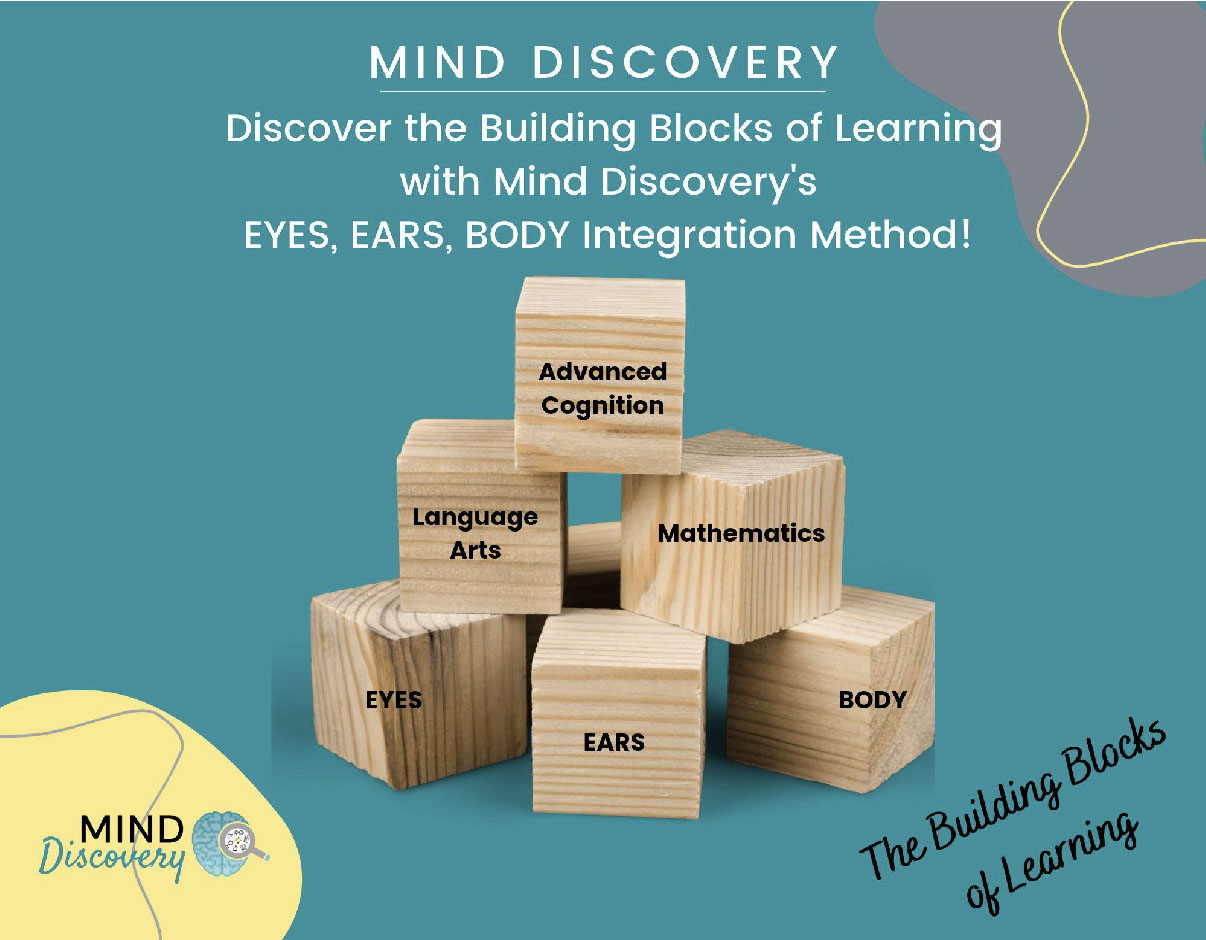
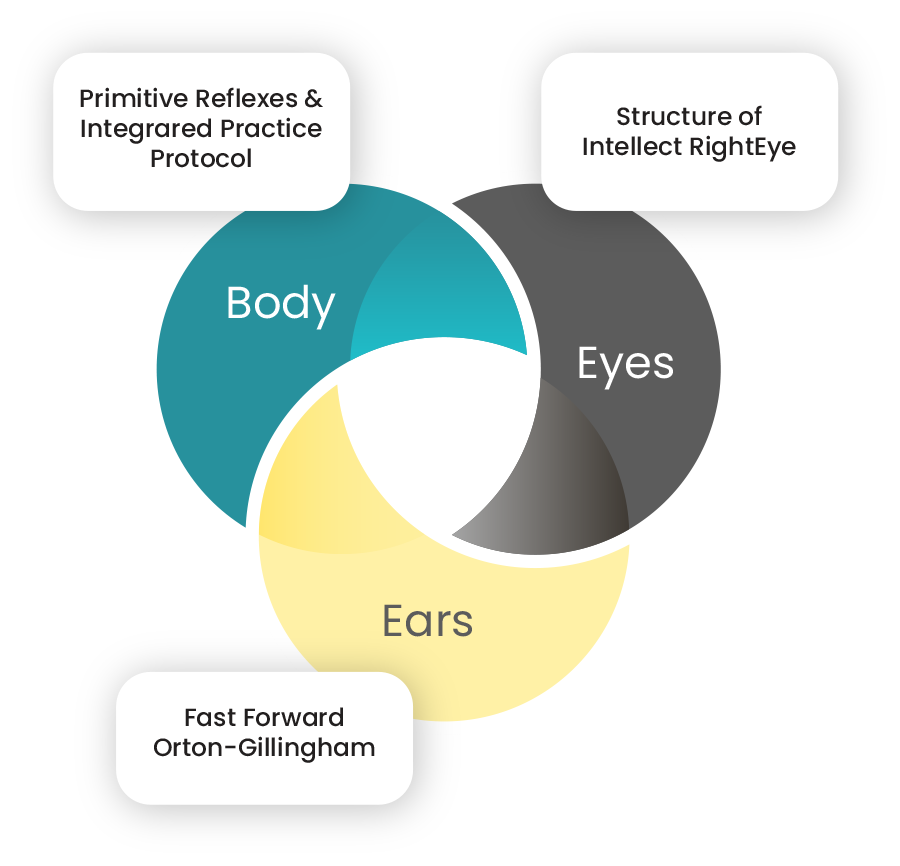
Mind Discovery’s patent-pending integrated educational methodology is organized around three interconnected developmental systems: Eyes, Ears, and Body, representing visual processing, auditory processing, and sensorimotor processing. Although each system contributes distinct functions, successful learning depends on their coordinated interaction with attention, memory, language, and executive-function networks.
Eyes: Visual Processing
Visual processing extends far beyond the ability to see clearly. It involves the brain’s capacity to recognize, discriminate, interpret, organize, and remember visual information. Visual attention, spatial awareness, visual memory, and visual-motor integration contribute to a student’s ability to engage with academic material. A child may demonstrate normal visual acuity while experiencing difficulties with functional visual skills, including maintaining visual attention, coordinating eye movements, copying written information, or organizing material spatially. These challenges may affect classroom efficiency, handwriting, and visually demanding academic tasks. At Mind Discovery, visual processing is considered within the student’s comprehensive learning profile rather than assumed to be the cause of a particular learning disorder.
Ears: Auditory Processing
Auditory processing involves the central nervous system’s ability to interpret, discriminate, sequence, and organize information received through hearing. These processes contribute to language development, auditory attention, and the recognition of sound patterns. Closely related phonological processing abilities are particularly important for literacy because they enable students to recognize and manipulate the sound structures of spoken language. Research in reading science has established the importance of phonemic awareness, phonological processing, and explicit instruction in sound-symbol relationships for developing decoding, spelling, and fluent word recognition. At Mind Discovery, auditory skill development is coordinated with structured literacy instruction informed by the Science of Reading and Orton-Gillingham principles.
Body: Sensorimotor Processing
Sensorimotor processing reflects the neurological relationship between sensory information, movement, posture, coordination, and spatial awareness. The vestibular system contributes to balance and movement perception, while proprioceptive pathways provide information about body position and movement. These systems interact with visual, tactile, cerebellar, and motor networks to support postural control, bilateral coordination, motor planning, and visual-motor performance.
Primitive reflexes are automatic motor responses that emerge during early neurological development. As the central nervous system matures, many of these responses become inhibited or incorporated into more sophisticated patterns of voluntary movement. Researchers have investigated associations between persistent primitive reflexes, motor coordination, and developmental differences, although evidence that reflex-integration exercises directly improve academic achievement remains limited. At Mind Discovery, primitive reflex observations are considered within a broader assessment of sensorimotor development, including balance, coordination, postural stability, and body awareness.
Together, these three systems contribute to the neurological foundations that support learning. Their interaction with attention, memory, and language illustrates why a comprehensive understanding of cognitive development can reveal educational needs that may not be immediately apparent through academic performance alone.
Neuroplasticity: The Brain’s Capacity to Learn and Adapt
One of the most significant principles in modern neuroscience is neuroplasticity, the brain’s ability to adapt and reorganize neural connections in response to experience, learning, and repeated practice. Throughout development, neural networks are continually refined as individuals acquire knowledge, strengthen existing abilities, and respond to new challenges.
Neuroplasticity is influenced by the frequency, relevance, and quality of learning experiences. Purposeful practice, appropriately challenging activities, meaningful feedback, and consistent opportunities for application contribute to skill acquisition. However, improvements in a practiced cognitive skill do not necessarily transfer to unrelated academic abilities. Effective educational interventions must therefore connect skill development with meaningful learning objectives and measurable outcomes.
Executive functioning is another important component of this process. Working memory allows students to temporarily hold and manipulate information, inhibitory control supports attention and behavioral regulation, and cognitive flexibility enables students to adapt their thinking when faced with new information. These abilities contribute to reading comprehension, mathematical problem-solving, written expression, and independent learning.
At Mind Discovery, principles of experience-dependent learning and executive-function development inform our individualized educational approach. We seek to identify specific cognitive strengths and challenges, provide structured opportunities for skill development, and connect those experiences with direct academic instruction.
The Mind Discovery Approach: Identification, Integration, and Remediation
Traditional tutoring generally focuses on reinforcing academic concepts, explaining unfamiliar material, and providing additional practice. While this approach can be highly effective, some students continue to struggle despite receiving appropriate instruction. In these situations, examining additional cognitive and academic factors may provide valuable insight into the student’s learning needs.
Mind Discovery’s integrated methodology connects cognitive development with individualized academic instruction through three coordinated phases: Identification, Integration, and Remediation.
Identification
During identification, comprehensive educational assessments and observations help establish each student’s cognitive, visual, auditory, sensorimotor, and academic learning profile. This process identifies individual strengths, specific skill differences, and areas requiring targeted support. Rather than relying exclusively on academic grades or standardized achievement scores, we seek a more complete understanding of the processes contributing to the student’s performance.
Integration
The integration phase incorporates individualized activities addressing identified visual, auditory, and sensorimotor skills while engaging attention, memory, coordination, and other relevant cognitive functions. These activities are selected according to the student’s needs, with ongoing progress monitoring guiding instructional adjustments. Our objective is to provide purposeful opportunities for developing foundational abilities while recognizing that academic progress must be evaluated independently.
Remediation
During remediation, students receive individualized, evidence-informed academic instruction in reading, mathematics, and other identified areas of need. Structured literacy, systematic phonics, explicit teaching, guided practice, and conceptual mathematics instruction are incorporated according to the student’s learning profile. Cognitive skill development and academic instruction are coordinated to support the application of developing abilities within meaningful educational tasks.
This integrated methodology reflects our belief that effective educational planning begins with understanding the individual learner and continues through targeted instruction, consistent practice, and measurable academic progress.
Building Stronger Foundations for Lifelong Learning
Learning is far more complex than memorizing information or mastering isolated academic concepts. It emerges through the interaction of neurological development, sensory processing, attention, memory, language, executive functioning, experience, and instruction. Every student brings a unique combination of strengths and challenges to the classroom, and recognizing those differences is essential to providing meaningful educational support.
For more than three decades, my work in education has been guided by a fundamental question: Why do intelligent, capable children sometimes struggle to demonstrate their true academic potential? That question ultimately became the foundation of Mind Discovery and our commitment to understanding learning beyond the surface of academic performance.
We believe that when educators examine the cognitive processes involved in learning, they gain valuable insight into how to individualize instruction, recognize overlooked strengths, and address specific barriers to academic success. By combining neuroscience-informed educational principles, individualized cognitive skill development, systematic academic instruction, and ongoing progress monitoring, Mind Discovery seeks to provide a comprehensive educational experience for students with diverse learning profiles.
The building blocks of learning are not simply letters, numbers, or academic concepts. They include the interconnected cognitive and sensory abilities that help children receive information, organize their thoughts, regulate attention, develop skills, and apply knowledge with increasing independence.
At Mind Discovery, we believe that understanding how a child learns is just as important as understanding what that child needs to learn.
Our mission is to help students build stronger foundations for learning, develop academic confidence, and make meaningful educational progress.
Developing Minds. Changing Lives.
Discover Your Child’s Learning Potential
If your child is experiencing difficulties with reading, mathematics, attention, memory, or academic confidence, understanding their individual learning profile may provide valuable insight.
Mind Discovery offers comprehensive educational assessments, individualized cognitive skill development, and targeted academic instruction designed to support students with diverse learning needs.
Contact Mind Discovery in Weatherford, Texas, to schedule a free consultation.
Scientific Research and References
The following research provides scientific context for the cognitive, sensory, and educational principles discussed in this article.
- Diamond, A. (2013). Executive functions. Annual Review of Psychology, 64, 135–168. https://doi.org/10.1146/annurev-psych-113011-143750
- Dehaene, S., Cohen, L., Morais, J., & Kolinsky, R. (2015). Illiterate to literate: Behavioural and cerebral changes induced by reading acquisition. Nature Reviews Neuroscience, 16, 234–244. https://doi.org/10.1038/nrn3924
- National Reading Panel. (2000). Teaching children to read: An evidence-based assessment of the scientific research literature on reading and its implications for reading instruction. National Institute of Child Health and Human Development.
- Zafeiriou, D. I. (2004). Primitive reflexes and postural reactions in the neurodevelopmental examination. Pediatric Neurology, 31(1), 1–8.
- Gu, C., & Bi, H. Y. (2020). Auditory processing deficit in individuals with dyslexia: A meta-analysis of mismatch negativity. Neuroscience & Biobehavioral Reviews.
- Schulte-Körne, G., & Bruder, J. (2010). Clinical neurophysiology of visual and auditory processing in dyslexia: A review. Clinical Neurophysiology.
- Bellato, A., et al. (2023). Association between ADHD and vision problems: A systematic review and meta-analysis. Molecular Psychiatry.
- Gieysztor, E. Z., et al. (2018). Persistence of primitive reflexes and associated motor problems in healthy preschool children. Archives of Medical Science.